Tuesday, March 13, 2007

Chicken bus to Luang Prabang

A 60 Baht ride from the hotel to the border, quick stamp on my way out, 20 Baht ride on a crowded bus over the Thai Friendship bridge, a $36 ($1 extra for packing my extra passport pictures so deep in pack that I chose not to retrieve it) and a 300 Baht taxi fare and then I was off to the Vientiane bus stop on my way to Luang Prabang, in the biggest piece of shit taxi imaginable.

Immediately after crossing the Thai-Laos Friendship bridge the median between the lanes widens, then criss-crosses at a traffic light with a large warning sign reading “In Laos, we drive on the RIGHT.” I had totally forgot about that. That cancelled out my plan of renting a motorbike. The next major difference in the two countries was the goats. Tons of them, every where. So many goats eating grass on the roadside and casually moseying into the hectic Laotian traffic of tuk-tuks, taxis, motorbikes and old ladies balancing oddly-shaped whicker containers over there shoulder on a bamboo pole. I found the traffic in Vientiane chaotic but when I looked around I noticed I was the only one who was worried. Everyone else driving amidst the dusty traffic was unaffected. They were neither bitching nor road raging, they weren't they screeching their breaks or screaming at near accidents. Their driving was business as usual.

As fluent as I might imagine myself to be in South East Asia, I managed to land myself in the shitty taxi, paying double the standard fare. When waiting for the driver to bring the car around I made small talk with a shop owner who gasped as my taxi rattled up to the shop. In Laos he said: “That is an a really ugly taxi, the ugliest taxi in Vientiane.” You can imagine my excitement. A sucker for punishment, I hopped in and then immediately regretted my decision when we pulled away and I realized the doors were missing handles to roll the windows down. It was a safe bet this taxi had no A/C.

The gruff driver rolled down his window and somehow reached back and jiggled one of my windows down. It was a dusty sauna of black carpet and black leather, with a small current of cooler, dusty air from outside passing through. I was told 300 Baht for the ride was a rip off but the ride was over 30 kilometers so I still feel like I got my money’s worth. That being said, if there was ever a taxi ride I would have liked to have ended quickly, this was the one.

Instead of staying in Vientiane, I decided to go straight to Luang Prabang to then work my way back south to the south before going home to Kalasin. At the bus station there were several signs advertising VIP buses to Luang Prabang but the few buses parked in the lot were a far cry from having A/C or a bathroom. The ticket counter confirmed my fears and told me the single bus in the lot that looked nice was headed to China and would not be willing to take passengers to Luang Prabang. I bought my cheap ticket for my chicken bus and waited for two hours while they stowed my bag in the back seats of the bus and stacked strange boxes and bags and random stuff on to the roof.

With a two hour wait and needing to work on my Laos, I started talking to a girl who was waiting to meet her mom. She was from Laos but worked at a coffee shop in Bangkok. She had traveled all the way there by bus to deliver her mom some cash and go back to make some more. When asked how many days they would spend together, she told me they would just meet and then each get on the next bus heading back out.

Other falang eventually rolled up, most with funky long hair cuts, worn in clothes, some with big sunglasses, and all wearing colorful but faded jewelry. There was mixed group of European dudes out to conquer the world one city at a time but going to each one and “doing it right.” They often told of the hangovers from the night before like they were injuries of war. They told me American Football was for pussies and that Americans were stubborn for not changing to the metric system.

Most roads in Laos are either under construction or should be. It’s not like the road of hell from Poi Pet to Siem Riep in Cambodia, but the edges of the road were buried in sand and dust and the pot holes were every where. The seats on the bus were average and did lean back but the windows were small sliders that would only open my window so far before pushing the person behind me’s window closed. Thus, we had to all be cordial with a bus neighbors and each share the medium flow of air.

Just leaving town I saw two monks sitting on a tractor while a man was pouring gas into the tank from a pitcher, a worker hoisting bricks up to the second story of a building one bucketful-at-the-end-of-a-rope at a time, and when we stopped in a small town old ladies would run up to our windows and try to sell us odd strips of grilled beef, guavas, and eggs-on-a-stick. For bathroom breaks we stopped in the middle of the nowhere so everyone could pee in the grass.

Up in the mountains the sun began to disappear and reappear from behind the mountains as we wound our way north. Just as the sun was about to drop for good, we arrived in Vang Vien and looking at my watch and thinking ahead of another 7 hours on the bus, I wished I was stopping there. But the ticket being paid for I decided to stick with it and ending up being the only falang left on the bus with 7 other people.

The red and orange hues hung in the sky for a while but when it was gone, the only thing I saw out my window was darkness. I fell asleep for a while then woke to see fires lighting up the mountains. From a distance the forest fires looked like thin veins of lava oozing down the mountain but as we would wind our way up, down or around the mountainside and eventually passed by them,they were so bright my eyes hurt.

Half way in the pitch dark 7 hour journey we stopped for dinner. I had some of that green stuff, some of this brown stuff, all on top of some rice, thank you very much. Before getting back on the bus I noticed the bus driver went to fridge and picked himself up the Thai bus driver night cap special: a couple cans of Beer Laos and a couple M 150s. Sap lie duuh.

The rest of the way there, the bus driver drove like we were rushing someone to the hospital. As he swerved left and right bottles and other garbage rolled from one side of the bus to the other with every jerk of the wheel. The overall rattling, shaking, clicking, jerking, high speeds and abrupt stops of the bus ride were very much similar to those of any rollercoaster worth waiting in line for. When it all came to an end, like some show on TV, I chose to believe that each of the 8 of us on the bus all became friends that day because we were each the survivor of a near death experience. We all waved good bye to each other at the bus station and wished each other good luck in our travels.

We arrived at 2:00 am, only two hours later than the bus driver had told. There were two tuk tuks waiting at the station but only one off the drivers woke up. Four of us shared a ride in the same one, them heading home and me heading out to find a guesthouse. Despite the noise coming from the tuk tuk, being outside I could hear how quiet it was at night in Luang Prabang. All shops were closed up, lights were off in homes, and nobody was in the streets. Then we got into town. We came to the local disco just as the bar has closing and suddenly we were in a sea of motorbikes rushing away like a motocross race. Drunk driving home from the bar, nobody wore helmets or drove carefully. They were all goofing around, driving along and still talking together before whisking off past our tuk tuk and on to some other party.

With one turn we lost all but a couple of them, and those even sped away quickly and again the town was quiet. The driver left me at the door step of a basic guesthouse where the owner who was sleeping next to his wife in the lobby under a mosquito net, woke up and showed me to a room. With sleepy eyes and no rush, he showed me a room, I took it, and before I could even ask how much, they guy just smiled and said, “tomorrow.”

Friday, March 09, 2007

It's spelled Laos but don't pronounce the "s"

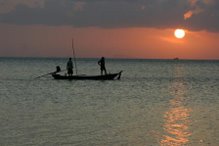
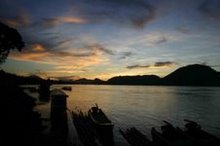
This is the last sunset for this trip to Thailand, reflecting off the Mekong. Across the river is Laos, where I'll be spending the next two weeks.

If you don't know anything about Laos it's the land locked country that borders Thailand's north-northeast. It's slightly bigger than Utah, with a population of roughly 5,750,000. It's basically made up of mountains and rivers and thus there are many waterfalls. That also means getting around can be a bit of a pain and often times the best way to get someplace is by river boat. It's an extremely poor country where over 30% of the population lives under the poverty level but from personal experience, I consider it to be one of the happiest places I've ever been. Life in Laos crawls by slowly and every one is laid back. Laotians are incredibly friendly, helpful and generous.

One of the most notorious and unbelievable statistics about Laos is that they are the most heavily bombed country in the world (per capita.) In what is called "The Secret War", during the Vietnam War our wonderful nation dropped over two million tons of explosives on Laos. I would guess most Americans have no idea whe ever dropped a single bomb on Laos, let alone a enormous amount. We bombed them more than all of Europe was bombed in World War II. Go us. I don't think they called it shock and awe back then. Anyways, now decades later the results are still disasterous (in Cambodia as well.) The countryside remians littered with bombs and mines that have yet to go off, prohibiting hiking in the mountians and visiting some historic sites.

Vientiane is the capital city but perhaps Laos' most well-known city is Luang Prabang. The city was declared a UNESCO World Heritage cite in 1995. The website briefly desrcibes the town as, "an outstanding example of the fusion of traditional architecture and Lao urban structures with those built by the European colonial authorities in the 19th and 20th centuries. Its unique, remarkably well-preserved townscape illustrates a key stage in the blending of these two distinct cultural traditions." Since you probably won't be able to make it out there anytime soon, check this link from the World Heritage website. It has incredible 360 degree pictures of several spots in the town.

http://www.world-heritage-tour.org/asia/la/luangPrabang/map.html

Laos is home to a myriad of different ethnic groups of numerous languages. This map shoes SE Asia and all of the different ethnolinguistic groups throughout the region. Many of these groups are the indigenous people everyone over here refers to as "hill tribes." Many of the traditional ways of life still intact, going from Thailand to Laos feels like taking a time machine back 50 years.

So as of tomorrow I switch from speaking Thai to speaking Laos, a linguistic jump not so difficult because the Isaan language I have picked up living in Kalasin happens to be, well, Laos. The two languages are very similar, even more so than say Spanish and Portuguese. Even more exciting is the anticipated switch from Thai beers to Beer Lao, a delicious alternative not imported to Thailand. On top of that, the remnants of French influence, good coffee and bakeries remain in the big cities. All I have to remember is that the food isn't "a-roy" (delicious), it's "sap."

Wednesday, March 07, 2007

Ex-pats like these make me feel like I owe Thailand a big apology

One afternoon in Loei, in an internet café amidst the drone of young Thai computer gamers' simulated machine guns, I was focused on a website when my concentration was interrupted by the smell of smoked cigarettes and liquor. The smell was familiar but distinctly not Thai. It was not the smell of liquor was not the lao kao or Sang Som whiskey, but something else. I looked around me to find the odor and of course, it was a falang.

Next to me was an old bald American hunched in his chair, leaning closely to his monitor and audibly swearing as he furiously clicked at a frozen website. When his fat index finger was tired he reached into his pocket and produced a small bottle of Bacardi and doused the already strong mixed drink in a large plastic cup.

His phone rang. He answered with a loud hello meant to show his disapproval and annoyance with the noise from the Thai kids. It was his wife. He spoke in a shameful mix of Thai and English. “Mai hungry. You gin mahk mahk. Me done, me tell you.” It was not a romantic picture of a love blossoming in spite of a language barrier, but the obvious laziness of a bothered drunk husband, uninterested in his subordinate wife. The few Thai words he barked loudly from his scratchy throat amounted to less than the basic vernacular or a first time Thai vacationer. He had obviously been in Thailand long enough to find a wife and move to the middle of nowhere, but I suppose knowing the local language would put him in position to communicate and thus listen to his wife.
Presumably his daugther, a young girl with pigtails and a bright smile skipped into the shop holding two oddly colored drinks in clear plastic cups. She sipped at her green drink while she offered him the purple drink proudly, with bright eyes. Papa falang was not impressed. Annoyed by the disturbance, he didn’t even try to use words this time. He looked at her and shook his head. He prodded at the purple drink with his finger then shook his hand no. He pointed the same fat finger down in his strong Bacardi mix showing her he already had a beverage. With that the girl’s smile was lost and she walked out of the café to sit alone on a bench with the two drinks.

Mr. Grumpy continued to work as his computer between gulps of liquor, hunting and pecking for his keys. He scowled at the monitor. I could smell the alcohol on his breath. His unhappiness obvious, I can't help but wonder, why is he here?

Tuesday, March 06, 2007

PHUKRADUNG


It is impossible to spell “Phukadung” with the limited vowels in the Roman alphabet, so for a westerner to pronounce the name of the national park correctly –or at least more similarly to Thai- it helps to know the origin of the name. The tallest mountain in the area, the top of Phukadung is actually a plateau slopping down to the east. As the story goes, on any “wan pra” or Buddhist holiday, the bells being rung at all of the local Wats can be heard from the peak. Phu (pronounced poo) is the Thai word for mountain. “KRA-DUNG” is the sound of a holy bell. Pronouncing the name like the sound of a bell, instead of reading it English, is more like the actual Thai pronunciation.
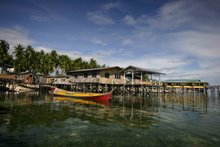
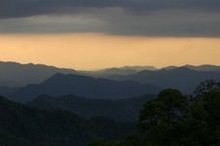
In the distance, just under the sunlight breaking through the clouds, you can see the right side of a Phukadung. Only reachable by foot, Taraneh and I had to spend a night in the town below before hiking up the 1,288 M mountain early the next morning.

For all of Phukradung’s natural beauty, it is an oddly touristy national park. All along the hike up the mountain are different rest areas with restaurants offering simple rice dishes, fresh fruit and cold water. At the steepest sections of the hike, steel or rock stairways have been built, meaning you can hike the whole way without getting your hands dirty.

On our way to the top, Taraneh and I took a minute to rest and saw an elderly woman hike past us, cruising along with a walking stick in her right hand, and using a fan to cool her self with the left. Taraneh with asthma and my weak self being out of shape, we decided to befriend Grandma (that’s the nickname we gave her) and keep pace with her. She told me she was hiking up to her restaurant on the top, that she had been making the hike once a week for as long as she could remember.

Not much further down the trail our party grew again. A group of college kids from Bangkok had come to make the hike. Perhaps because of our good company or our slow but consistent pace, they stuck with us and like that, we went from two to ten.

Like our friends from Bangkok, larger groups scaling the mountain can hire others to carry up their packs for them. The rate was 30 Baht a kilogram. For this cheap price, a man or woman would strap your belongings to a bamboo pole and walk it up the mountain on their shoulders. These poor guys earned every Baht of their wage, slowly working their way up the nine kilometer hike one sure-footed step at a time.


When we reached the top in just over three hours our new acquaintances were good friends. Still over three kilometers from camp, we baked in the sun unshaded by the few tall trees.


Despite Phukradung’s touristy bits, it has conserved its natural beauty. The rainy season is the ideal time to go, when the fields are in bloom with thousands of flowers, the cool air giving distant views of the countryside, and the rainfall feeding several impressive waterfalls. Sadly, it is the cool season and we saw few flowers and all but one waterfall was dry. There were several advantages however. One, there were fewer tourists in the cool season, and two, without the rain, there were no leeches. Other than that, the animal life remained similar year round. We were kept away from different trails without guides because of wild elephants, and large deer, unafraid of humans, frequently walked around the campground.


After setting up our tent and having dinner at Grandma’s restaurant, we caught sunset at a cliff several kilometers away. We found a spot on a rock overhang and stared off into the countryside. Ice being a rare and expensive commodity, we drank warm beers as the sun fell below distant mountains. The alcohol going straight to my head, the sky was a living watercolor painting. The heat cast a haze over the sky, that made apparitions of the mountains in the distance, visible one minute then gone the next. In the valleys we saw only a carpet of treetops, spotted with the occasional shimmer of sunlight reflecting off a pond. When the sun fell out of our sight, we walked back under the last of the days light.

Before the sun had risen again, we woke early the next day to walk even further to the opposite side of the plateau for the sunrise. Unknown to us before the trip, that morning was a lunar eclipse and as we walked in the morning’s darkness we were watched the earth’s shadow slowly creep across the moon’s surface. In the stillness of the AM, we heard only the wind blowing across the plateau but we didn’t feel the breeze until we reached the edge. The moon no longer visible we, along with dozens of others, shivered in the darkness looking at our watches.

Slowly the trees became dark shadows against orange streaks appearing across the sky. As the orange warmed to red and shades of blue and the whites of clouds became visible, cameras began to flash. They didn’t stop, capturing snaps of every minute, every hue, every shade, until the sun had fully appeared and everyone turned off their cameras and left.

That day we set out on a hike with our college friends, a local Phukadung fanatic (he had climbed it 6 times already) and a professor who said he had climbed it so many times he had lost count. The professor led us around like a tour guide, telling us about the two-needle and three-needle pines, the rock orchid, the lichen that only grew in pristine, unpolluted areas, snapping group pictures at every major stop.

Along the hike we stopped to pray at a large Buddha image adorned with dozens of bells of different shapes and sizes. Further along we came to a pond famous for being the swimming hole of fairies of Thai lore. For lunch we found a dense forest bordering a small river and ate rice dishes Grandma made for us out of plastic bags. Eventually we reached the opposite cliff and hiked along it the rest of the way, stopping to rest where there were good views or plenty of shade.


The round trip was just over 20 kilometers. The half-way point of our trek was this cliff, a famous spot amongst Thais but little known to foreign tourists. Protected only by this warning and feeling the gusts of wind along the edge, I felt dizzy anywhere near the rock. Taraneh on the other hand walked right out to the edge and sat down as if it were impossible to slip and plummet to a horrible death below. I worked up the guts to this other ledge, a spot where wussies like me can still pose for a cool photograph.


After two straight days of hiking, we were spent. When the sun went down, we fell asleep. The next morning we slept in before gathering our things and hiking back down the hill.

How do you eat birthday cake?


My students never asked me this question and I never thought about teaching it, but oddly enough, Thais have no idea how to eat a birthday cake.

Twin students of mine, Ing and Iw, threw their own 17th birthday party at a local Korean barbeque restaurant on one of my last days in Buakhao. Lara and I were guests of honor and we brought cake and candles to show the students what western b-days are like.

Thais don’t normally celebrate birthdays at all. They rarely give gifts to the birthday boy or girl, almost never eat cake and most don't have even a small party. But Ing and Iw are hip to falang culture and they took advantage or the opportunity to have some fun. They invited their closest friends who happen to be my best students.

After dinner we brought out the cake and candles and explained the tradition of having a candle per year, singing “Happy Birthday”, then making a wish and blowing out the candles. The 17 candles took up all the room on the cake and the girls lit the outside candles first making it nearly impossible to light the inner candles without burning their fingers. This was only the first of their newbie birthday mistakes.

Then we sang “Happy Birthday” without the refrain “happy birthday, dear _____” which Thais replace with saying happy birthday twice, just for simplicity. Ing and Iw were excited when they blew out all of the candles and thus granting their wish. But then they quickly blurted out their wishes to their friends (to get good grades) and blew it. I had forgot to tell them about the superstition attached to the wish-making, that if you tell anyone your wish, it won’t come true. They were dissapointed, but as all Thais do when they're dissapointed, they laughed.

With a knife from the kitchen, the girls began to cut their cake together, each with a hand on the handle of the knife. Lara and I looked at eachother. Then the kids started singing, “Dah, dah, da-dah” – the wedding song. Lara and I looked at each other again, both realizing that yes, they had mixed up the traditions. Then Ing and Iw fed each other pieces of the cake, each threatening to shove the cake in the other’s face. Lara and I laughed.

Wedding cake rituals aside, they cut out two pieces of cake, handed them to Lara and I on plates, and then passed out spoons to everyone else. Like the begining of a race, the entire group of girls quickly swiped at the cake (minus two slices) in a mad spoon free for all. First went all of the icing, leaving just a strange, deformed mound of cake but in less than half a minute only small crumbs were left.